
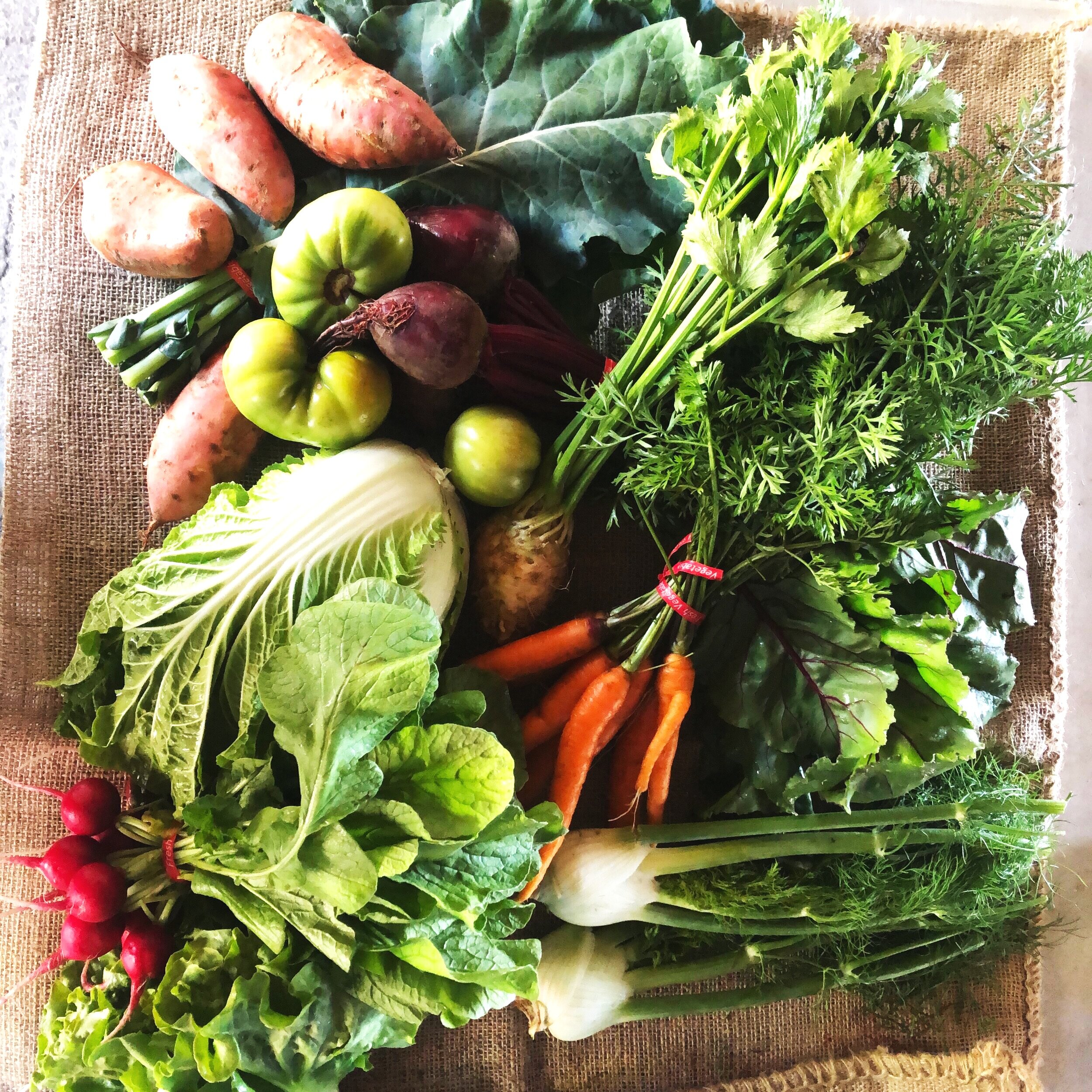

High quality food is a human right.
LGBT+ and BIPOC farmers are uniquely positioned to address food insecurity and transform our food system by overwhelmingly utilizing more sustainable, regenerative, community-connected approaches.
Of all food grown at Rock Steady and routed through our offerings, between ~75% (varies annually) of it gets distributed for free or low cost to low income community members facing food insecurity. Through our sliding scale CSA and no-cost Solidarity Shares, as well as a network of 12+ wholesale food access distribution partners, we provide free and subsidized produce to thousands of queer and trans folks, BIPOC folks, seniors, families with young children, immigrants, low-income households, and people living with serious health concerns.
Along with a vast and growing network of regional partners, we are developing coalition-driven and resilient QTBIPOC-led supply chains and distribution networks across the state. We are creating alternatives to extractive, exclusionary, ways of working and re-imagining our local food shed by centering QTBIPOC leadership. Together, our growing collaborative networks produced, aggregated, and distributed 1.4+ million pounds of food in 2025.
“There’s no better feeling than being able to feed your family whole nourishing meals. ”
Contribute
Your tax-deductible donation will support our efforts to get food on the tables of those who would otherwise go without it. Thank you for helping your community access fresh, local produce!
“I would like to express my gratitude for your solidarity shares. They make such a difference when otherwise it is so difficult to have access to local fresh produce. You make it seem like the world is not just an unjust place. It means so much for me. Thank you!”
It’s all connected.
When you contribute to our Food Access initiative, you’re not only feeding community members in need, but also supporting the sustainable farming practices behind that food.
Amidst an escalating climate crisis, we take our responsibility as farmers and land stewards seriously. Industrial agriculture is responsible for 24% of global greenhouse gas emissions. On the other hand, small scale, sustainable farms like ours have the power to reverse this harm through regenerative agriculture practices that sequester carbon, rebuild soil health and increase biodiversity.
Each of these choices require planning, hard labor and significant financial investment. As a result, our vegetables do cost more than those grown conventionally on large scale farms without regard for the soil.